Module 3
Macroinvertebrates and Health of Inland Water
Aquatic macroinvertebrates, such as snails, worms, shrimp, midge and mosquito larvae, water mites and beetles, are an integral part of a healthy water ecosystem. They are the food for carnivorous invertebrates, fish, and birds. They live all, or part, of their lives in water and their survival is closely linked to the quality of the water. Each type of macroinvertebrate needs particular environmental conditions to survive, reproduce and grow. Some are more sensitive to pollutants than are others; thus, monitoring these macroinvertebrates is a guide to the level of pollution in the water system.
Sensitive - organisms in the Orders Ephemeroptera (mayfly nymphs), Plecoptera (stonefly nymphs) and Trichoptera (caddisfly larvae), collectively known as EPT are very sensitive to pollutants.
Tolerant - Orders include Odonata (dragonfly larvae), Hemiptera (water strider) and Diptera (mosquito larvae/pupa).
Most tolerant are Chironomidae (nonbiting midges), subclass Hirudinea (leech), Phylum Nematoda (roundworms) and subclass Oligochaeta (segmented worms).
From the Expert
… “The scientific world is still coming to terms with the huge diversity of more than 1000 species of aquatic invertebrates in the Wheatbelt, many of these species are not known from anywhere else in the world and this is especially true of the naturally saline playas, and ephemeral freshwater wetlands, including pools on granite outcrops. The diversity of water birds, and especially invertebrates, give important clues to the functioning of a wetland. For example, of particular concern is the spread of the introduced brine shrimp Artemia sp. in water systems that were formerly the preserve of our native brine shrimp, Parartemia sp. Salination, acidification, and weed invasion, as well as the changing climate, will have consequences for wetlands in the Avon Valley wetlands, and the Wheatbelt region…”
Forward by Dr Brian Timms to Aquatic Invertebrates and Water Birds of Wetlands in the Avon Region (by Susan Jones, Cara Frances, Anna Leung, and Adrian Pinder, 2009) IN: https://library.dbca.wa.gov.au/FullTextFiles/025027.pdf

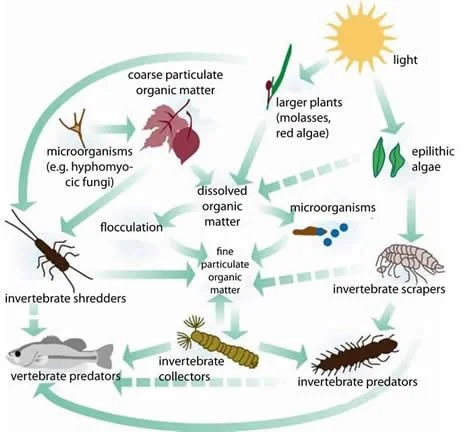
Example of an Aquatic Food Web Source: PrinctonHydro.com
Activity
Collect a Sample for Macroinvertebrate Analysis:
Method
1. At the collection site, students use the aquatic macroinvertebrate scoop net on a handle.
2. Take 10 minutes for the exercise and make several sweeps in the water body ensuring a wider representation of habitats is sampled.
a. Collecting at the edge of a water body, near stones, logs, and vegetation, beat and scrape your net against the base of the aquatic plants.
b. Collecting in running water, use kick sampling as follows: select an area within the water body that is shallow enough to stand in, about knee deep. Face downstream, submerge the net so it is in front of your feet on the floor of the riverbed, and position the mouth of the net so it's facing upstream. Shuffle, and kick the ground so the sediment, rocks etc are disturbed. Slowly walk backwards for five metres, continuing to kick and shuffle the ground.
c. Collecting in slow moving water, use sweep sampling as follows:
(i) sweep the net across the surface and drag it through the water in a figure of eight motion.
(ii) empty the contents of the net, each time, into the 3L lidded container containing about 2L of stream water.
(iii) agitate the net gently for 30 seconds to remove animals.
(iv) check all organisms are removed from the net.
(v) return the container to the school laboratory and maintain the samples at 4oC for analysis of the macroinvertebrate pollution index in the following class.
Collecting methods are adapted from: Waterwatch, South Australia, at: http://www.waterwatchadelaide.net.au/index.php?page=sampling-techniques
Activity
Recording Macroinvertebrates in Inland Water:
Students understand that the greater number of different invertebrates they find (biodiversity), and the more sensitive they are (on the pollution index), the higher the water quality must be.
PREPARATION
· Bring the macroinvertebrate collection to room temperature.
· Download Magnifier, from the App store to student i-Pad.
· Print off WORKSHEET 5 - Macroinvertebrate Survey Sheet (TOOLBOX)
· Download and print off Aquatic Macroinvertebrate Identification Key https://www.uwa.edu.au/study/-/media/Faculties/Science/Docs/Aquatic-macroinvertebrate-Identification-key2.pdf
MATERIALS
· 2 white sorting trays
· 4 white ice cube trays
· plastic spoons to sort macroinvertebrates
· hand lens or magnifying glass or dissecting microscopes
· iPads with the Application ‘Magnifier’.
METHOD
1. Empty the stream water into 2 white collecting trays. It is important that the macroinvertebrates can be seen easily in the trays. If there is a lot of debris, use several trays.
2. Isolate each organism, if possible, using the spoon and place it in about a few drops of pond water in each compartment of the ice-block tray.
3. Samples may be examined using a dissecting microscopes (x4), or hand lens, or photographed using student i-Pad containing App Magnifier.
4. Students identify each macroinvertebrate, using the Aquatic Macroinvertebrate Identification Key
5. Enter data (ID of invertebrate and numbers counted) into WORKSHEET 5 - Macroinvertebrate Survey Sheet in the appropriate box (under TAXA RICHNESS).
6. Combine all data into a Class Macroinvertebrate Survey Sheet.
Activity
How to Calculate a Signal Score:
SIGNAL (or, Stream Invertebrate, Grade Number – Average Level) SCORE is a measure of the number of macroinvertebrates found, and their degree of sensitivity to pollution. Adding up their sensitivity scores indicates the quality of the water animals are living in.
The Sample Macroinvertebrate Survey Sheet (TOOLBOX) will help students to understand how a Signal Score is calculated.
From the Survey Sheet,
· have students note the following invertebrates were found: Freshwater shrimp, Whirligig beetle, Isopod, Damselfly nymph, Water boatman, Backswimmer, Caddisfly larva and Yabby.
· the Total of different macro invertebrates is 8, providing a TAXA RICHNESS of 8.
· SCORE is entered for each animal’s Sensitivity to Pollution number (ie. 8 for Caddis fly larva, 3 for Damselfly nymph, etc.
· if 2 Damselfly nymphs were found, SCORE will be 6.
· total the SCORES to find a POLLUTION RATING - in the example, it is 27.
· the SIGNAL SCORE is calculated by dividing the POLLUTION RATING by the TAXA RICHNESS.
in the example, 27 divided by 8 = 3.3, giving a SIGNAL SCORE of 3.3, indicating moderate pollution.
Activity
Calculating a Pollution Index for Inland Water:
METHOD
1. Using the Class Macroinvertebrate Survey Sheet (from Activity 8), students total the invertebrates and their SCORES (as in the sample above).
2. Calculate a SIGNAL SCORE from the data.
3. Using the SIGNAL SCORE, refer to the Pollution Rating Table, for a level of pollution in the waterway investigated.
4. Record the results.
5. Return the macroinvertebrates to the water body if possible; they provide food for other organisms.
Activity
Write the Field Report, Using All Data :
· Discuss what management strategies could be used at a water body to maintain health or to improve health.
· Write ideas on a ‘sticky’ note and stick onto a WordWall
· Suggestions might include (i) restrict numbers of people using the water body (ii) ban fires (iii) fence the area (iv) improve signage (v) install rubbish bins (vi) corral feral animals and (vii) manage septic tanks.
· Collate all ideas
· Discuss who should receive it.
Activity
Construct a Food Web for the Inland Water Investigated?
Using WORKSHEET 6 - Diets of common aquatic species (TOOLBOX), construct a food chain for your inland water studied.
Glossary
Active transport – specialised cells in membranes (gills, kidney, alimentary tract) that use energy to secrete and absorb ions such as sodium across the membrane.
Alkali – chemical compound that neutralises an acid.
Acid – a molecule or compound that can donate a proton or accept an electron pair in reactions.
Base – A substance capable of accepting or neutralizing hydrogen ions; reacting with an acid to form a salt and water.
Hydroxyl Ion – the ion OH-, denoting a water molecule that has lost a proton (H+).
Ions – atoms or molecules with a net electric charge due to the loss or gain of one or more electrons.
Neutralization – a chemical reaction in which an acid and a base interact with the formation of a salt; with strong acids and bases the essential reaction is the combination of hydrogen ions with hydroxyl ions to form water.
Permeability – is a porous material’s ability to pass water through its pores.
Porosity – is the amount of water that a material can hold in the spaces between its pores
pH – notation expressing the acidity or alkalinity of a solution on a logarithmic scale
pH scale – a scale from 0 to 14 reflecting the concentration of hydrogen ions in solution; the lower numbers denote acidic conditions, and the upper numbers denote basic, or alkaline, conditions.